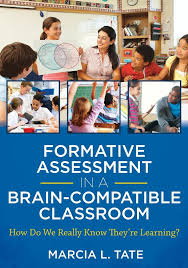
 Formative Assessment - Dr Marcia Tate
Marcia Tate’s website here
If you wait until you have planned your lesson to decide how you will assess it, you have waited too late! Once you have decided what you want students to know and be able to do, the second question becomes How will I know when they can do it?
This highly-engaging keynote deals with effective questioning and assessing those products and performances that tell us whether students are really learning. It also delineates four ways that students can knock the top off any test! This keynote has been called informative, practical, and a great deal of fun!
This will be the highlight of the week, formative assessment, following a big lunch and Sir Ken Robinson. I only hope she does something special! The eyes glaze over. TEGO
How do we know they are learning? - Her big question.
See her book above.
Students see assessment results visibly , no other way.
How do we know they are learning - see Page 52 of your handout. Key are higher order thinking questions. Bloom’s Taxonomy. She gave us the task to create questioning in evaluating and creating areas.
Ask higher order questions.
Page 54 - we were asked to work together to come up with:
a)- list 5-7 products of how students can present work in your fine school. Eg. books, reports blog, drawing, essay, journal, model
b)- 5-7 performances - starts with verbs eg. sing a song, experiment, re-teach something, role-play, solve a problem, debate, etc
Plenty of Sing along to science examples on this website.
CRI about Rubrics
- Criteria or Dimensions
- Rating Scale
- Indicators
Involve students in the creation of rubrics if they are old enough.
See birthday party rubric on page 55 of handout. Remember the rubric.
Be SAD about rubrics
- Specific
- Attainable
- Defendable
See her sample rubrics in the handout.
Rubistar4teachers.org Useful website for establishing rubrics.
Four ways to assess
- Teach tested objectives
- Deliver instructions using brain compatible strategies. - See lesson plans in your handout. Page 57 - 20 strategies

- Familiarise students with the test vocab and format.
- Give students the confidence that they will achieve.
Brain research shows that writing long-hand is far more effective for remembering material than typing.
Finished with story of her son who now works in military.
SMILE - Show Me I’m Loved Every day
My reflections: How many of the 20 Brain Compatible Strategies are we seeing used in our classrooms?
How is higher order questioning being deliberately planned into our lessons/inquiries?
Share some of Marcia's youtube club about greeting, laughter, music with staff ...
My reflections: How many of the 20 Brain Compatible Strategies are we seeing used in our classrooms?
How is higher order questioning being deliberately planned into our lessons/inquiries?
Share some of Marcia's youtube club about greeting, laughter, music with staff ...
Comments
Post a Comment